
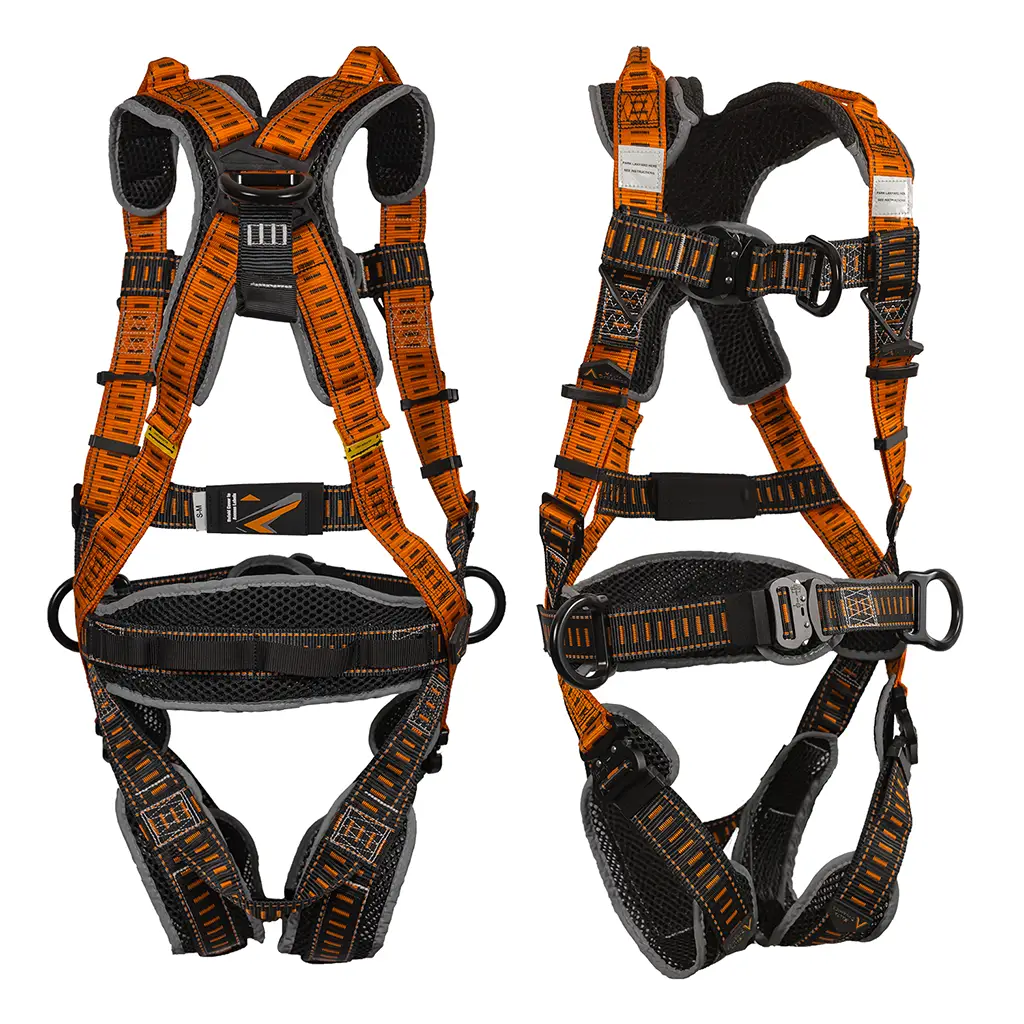
A harness is a system of straps and buckles that wrap around your body and connects you to an anchor point. Keep your crew protected and productive with the right harness.
This guide breaks down the harness types that matter for your work and what you need to know to pick the right protection for your crew.
Basic Components of a Safety Harness
Know your gear. Every component of your harness has a job to do.
Webbing and Straps
The webbing system spreads the force of a fall across your body. Made from polyester or nylon, these straps are built for strength and durability. The key parts are:
- Shoulder straps: Keep the harness in place and distribute force
- Leg straps: Support and stabilize the lower body
- Chest strap: Prevents shoulder straps from separating
- Back web: Holds the dorsal D-Ring and ties the system together
- Sub-pelvic strap: Supports weight and prevents slipping through the harness
Impact Indicators
Impact indicators are visual safety features built into harnesses that change appearance (such as tearing stitches or color-changing elements) when subjected to fall arrest forces, providing clear evidence that the harness has experienced impact loads. If the impact indicator has been deployed, the harness must be removed from service.
Hardware and Attachment Points
D-Rings are steel or aluminum ring-shaped attachment points that connect to lanyards or SRLs. These connection points are where your harness attaches to fall protection equipment. They’re the most critical part for your safety.
The number and location of D-Rings determine what your harness can handle. They are named by the number of points.
- A 1-point harness has only a single dorsal D-Ring and is built for basic fall arrest.
- A 2-point harness (or multi-point) includes additional D-Rings in different spots, giving you more options for different types of work like positioning, climbing, or rescue operations.
Here’s a breakdown of the types of D-Rings:
- Dorsal (back) D-Ring: Your main connection point for fall arrest systems. Sits between your shoulder blades to spread forces during a fall.
- Side D-Rings: Located on your hips, these let you connect positioning lanyards for hands-free work while leaning against vertical surfaces.
- Front/sternal D-Ring: On your chest, used for climbing and some rescue situations where you need forward attachment.
- Shoulder D-Rings: Specialized attachment points on your shoulders for rescue operations to keep you upright when being lifted.
Buckles: Buckles connect the straps around your body. They come in tongue-and-buckle or quick-connect styles.
Additional Features on Some Harnesses
- Padding: Reduces pressure points and fatigue during extended wear periods
- Seat support: Provides stability and comfort during prolonged suspension work
- Trauma suspension strap: Prevents venous pooling and maintains circulation during post-fall suspension
- Reflective materials: Enhance visibility in low-light and nighttime working conditions
Types of Harnesses
Full-Body Harnesses
This is your standard fall protection harness. A full-body harness wraps around your shoulders, chest and legs with a dorsal D-Ring for connecting to lanyards or SRLs. They are required by OSHA 1910.140 for fall protection work and are what most crews use for basic construction.
Applications: General construction, roofing, maintenance work
Standards: Must meet ANSI Z359.11-2021 requirements
Capacity: 130-310 pounds
Malta Dynamics Options:
- Warthog Tongue and Buckle Harness: Reliable full-body design with secure tongue-and-buckle connections
- Javelina Harness: Economic option with quick-connect chest buckles for a faster set up
Multi-Purpose Harness
When you need more than just fall arrest protection, multi-purpose harnesses give you options. These are full-body harnesses with extra D-Rings in the front, back and sides so you can handle fall arrest, positioning and rescue work with one harness.
Applications: Ideal for workers who need one harness to handle multiple tasks-fall arrest, positioning and rescue.
Key Features: Multiple D-Rings, enhanced adjustability
Malta Dynamics Options:
- Razorback Elite Sternal D-Ring Harness: Lightweight design with front, back and side D-Rings for versatility
- Warthog Comfort MAXX: Padded harness with removable belt and side D-Rings for comfort during long shifts
Work Positioning Harness
Work positioning harnesses are engineered for hands-free operation on vertical surfaces, featuring side D-Rings and integrated waist support that securely hold workers in position during tasks. These harnesses enable full use of both hands while maintaining proper body positioning and fall protection.
Applications: Window cleaning, electrical work, building maintenance
Key Feature: Side D-Rings allow workers to lean back while working
Malta Dynamics Options:
- Warthog Side D-Ring Harness: Straightforward positioning harness with side attachment points
- Warthog MAXX Belted Side D-Ring: Upgraded version with padded belt and tool attachment points
Rescue/Confined Space Harness
Rescue work requires specialized gear. These harnesses have shoulder or chest D-Rings designed to keep you upright during retrieval operations. This harness prevents inversion during vertical rescue.
Applications: Confined space entry, rescue operations
Key Feature: Attachment points positioned to prevent inversion during rescue
Malta Dynamics Options:
- Razorback Elite Sternal D-Ring Harness: Lightweight design with front, back and side D-Rings for versatility
Rope Access Harness
For jobs requiring controlled ascent and descent, rope access harnesses are built for extended suspension work. They include seat support and front attachment points so you can work comfortably while hanging from ropes.
Applications: Building inspection, maintenance work requiring rope access
Key Feature: Integrated seat support and padding for suspended work
Body Belts
While safety belts were commonly used for fall protection in the past, research in the 1990s revealed serious safety issues that led to their prohibition.
OSHA Requirements: Body belts have been prohibited for fall arrest applications since January 1, 1998. They may only be used for positioning work where no fall potential exists.
Full-body harnesses, now the standard for fall protection, distribute fall arrest forces across the thighs, pelvis, chest and shoulders rather than concentrating them at the waist. This improved design allows workers to survive suspension for 20-30 minutes, providing adequate time for rescue operations.
How to Choose the Right Harness
Step 1: Identify Your Industry Requirements
Different industries have specific harness requirements based on work applications and environmental hazards.
- Construction: Durable harnesses with back D-Rings for fall arrest.
- Roofing: Lightweight harnesses with leading-edge connections for mobility.
- Utilities/Electrical: Arc-flash resistant materials with specialized attachment points.
- Oil and Gas: Flame-resistant harnesses for chemical exposure.
- Confined Space: Shoulder D-Ring harnesses for quick rescue retrieval.
- Tower/Telecom: Front and back D-Rings for climbing and positioning work.
- Warehousing: Basic lightweight harnesses for maintenance on elevated platforms.
- Steel/Structural: Heavy-duty harnesses with multiple D-Rings for positioning work.
- Welding: Heat-resistant materials like Kevlar with high-temperature hardware.
- Wind Energy: Specialized turbine harnesses with rescue capabilities and comfort features.
Step 2: Determine Your Application
Full-body harnesses are required for any application where a fall could occur. The only exception is true positioning work where no fall potential exists. Most companies use full-body harnesses for everything because they provide more versatility and safety options. Here are some applications to help you make your decision for what harness you need:
Fall Arrest
Through the usage of dorsal D-Rings and full-body load distribution, workers exposed to fall hazards of six feet or more are protected by safely arresting their descent and maintaining proper body positioning during suspension.
Recommended harness: Warthog Tongue and Buckle Harness
Ascending/Descending
Through the usage of front D-Rings and integrated seat support, workers have controlled vertical movement up or down structures during extended climbing or descent operations.
Recommended harness: Razorback Elite Sternal D-Ring
Rescue/Confined Space
Through the usage of shoulder D-Rings and specialized attachment points, workers are maintained in an upright position during rescue operations and confined space entry or retrieval procedures.
Recommended harness: Razorback Elite Sternal D-Ring
Climbing
Through the usage of multiple D-Rings and positioning attachment points, workers are capable of secure movement and positioning during ladder work or climbing operations where fall distances are typically two feet or less.
Recommended harness: Razorback Elite Sternal D-Ring
Positioning Work
Through the usage of side D-Rings and waist support, workers are capable of leaning back and utilizing hands-free work on vertical surfaces.
Recommended harness: Warthog Side D-Ring Harness
Step 3: Select Your Configuration
The configuration of your harness affects how it fits, how easy it is to use and how comfortable your crew will be wearing it all day.
Strap Design:
Choose based on how much you move around on the job.
- H-Style: Straps cross on your back, best for active work and movement
- Y-Style: Straps meet at one point, lighter and good for basic fall arrest
Buckle Type:
Choose security vs. speed based on your work pattern.
- Tongue-and-Buckle: Most secure, takes longer to put on
- Quick-Connect: Faster like a seat belt, good when crews get in/out frequently
Padding:
More padding = more comfort but higher cost. Choose based on your needs.
- Standard: No padding, lightest and cheapest
- Shoulder Padding: Essential for workers wearing harnesses four or more hours daily
- Full Padding: Worth it for long shifts or suspended work
Step 4: Ensure Proper Size and Fit
Even the best harnesses won’t protect if it doesn’t fit correctly. The proper fit is critical for safety and comfort. A harness that doesn’t fit right won’t protect you in a fall. Most harnesses accommodate workers from 130-310 pounds with universal sizing, but fit is more important than weight capacity.
Fit Requirements:
- Dorsal D-Ring positioned between shoulder blades: This is where your lifeline connects, so it needs to be centered on your back. If it’s too high or low, fall forces won’t distribute properly across your body.
- Sub-pelvic strap positioned under your buttocks: This strap catches your weight during a fall and keeps you from falling out of the harness. It should sit snug under your rear end, not on your hips or thighs.
- Chest strap 6-8 inches below throat: Position it at mid-chest level. Too high and it can choke you during a fall, too low and it won’t keep the shoulder straps in place.
- Snug fit without restricting movement: Can you fit more than two fingers under a strap? It’s too loose.
Step 5: Verify Standards Compliance
All full-body harnesses must meet ANSI Z359.11-2021 standards. This standard establishes requirements for performance, design, marking and testing.
Key Requirements:
- User capacity range of 130-310 lbs
- Visual load indicators
- Proper labeling and documentation
- Testing to specified force requirements
Making Your Selection
For most general construction work—like roofing, framing, maintenance and light industrial tasks—a standard full-body harness with a dorsal D-Ring provides reliable fall protection. If your team doesn’t need specialty features, keep it simple.
However, certain jobs call for more. Workers requiring positioning capabilities need harnesses with side D-Rings for hands-free work. Crews spending long hours in harnesses benefit from padded designs that reduce fatigue and increase productivity. Specialized environments like confined spaces or rescue operations require harnesses with multiple D-Ring configurations and rescue-specific features.
Choosing the right style is only part of the equation. A harness must fit correctly and be inspected regularly. An ill-fitting harness can be just as dangerous as no protection at all.
Choose Equipment From a Manufacturer You Trust
At Malta Dynamics, we don’t just manufacture fall protection gear-we rely on it. Our harnesses are designed and tested by experienced professionals who understand the challenges of working at height because they’ve been there themselves.
Every product exceeds ANSI and OSHA requirements and includes comprehensive documentation for compliance verification.
Need help choosing the right equipment? Our fall protection experts are here to help. We’ll work with you to find the right solution for your specific needs and budget.
